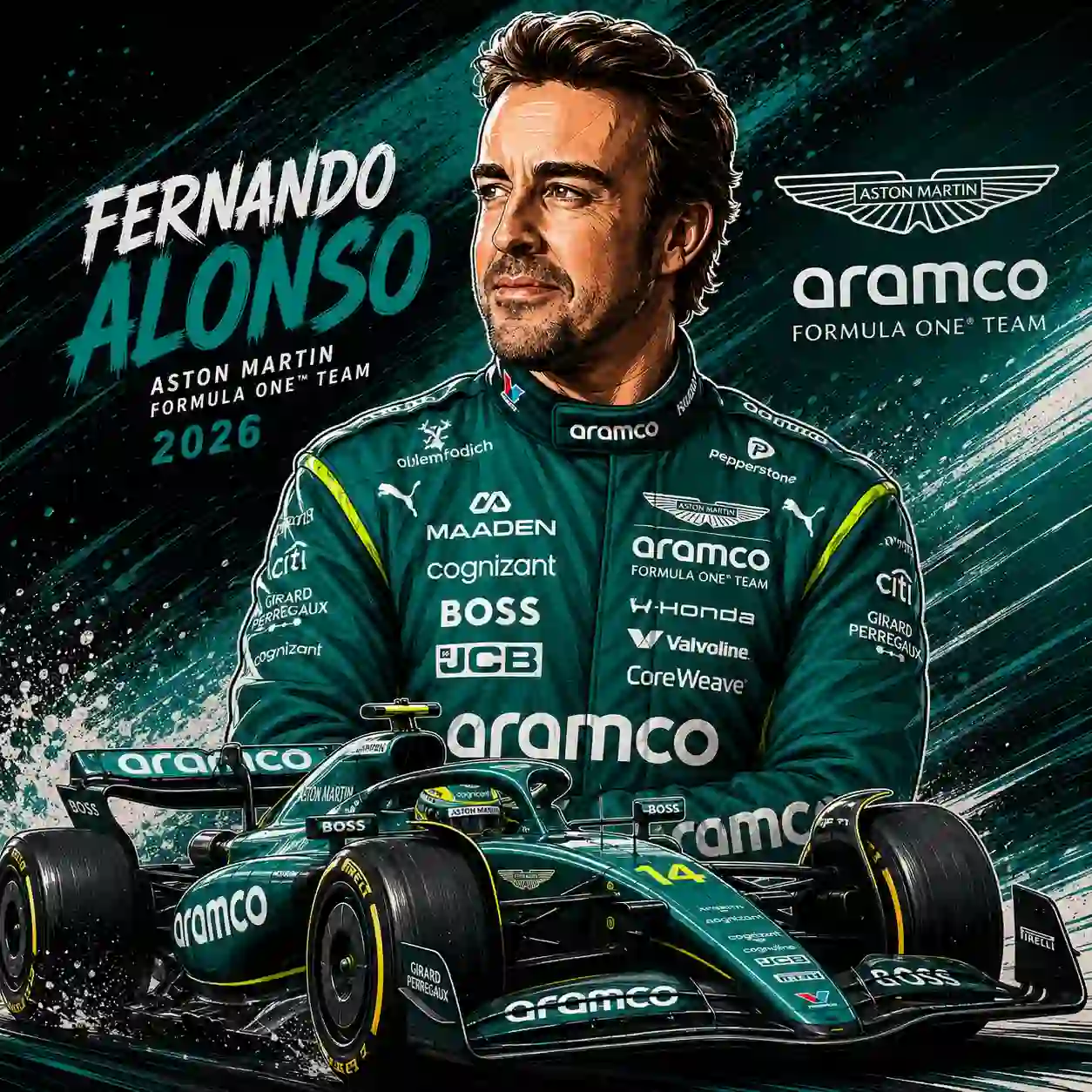
Fernando Alonso
July 29, 1981 · Oviedo, Spain
Last updated: August 21, 2026
World Championship Titles
Career Statistics
Season Breakdown
| Season | Team | Races | Grand Prix Wins | Podiums | Points | WDC Pos. | Details |
|---|---|---|---|---|---|---|---|
| 2026 | aston martin | 16 | 0 | 0 | 7 | 18 | |
| 2025 | aston martin | 24 | 0 | 0 | 56 | 10 | |
| 2024 | aston martin | 24 | 0 | 0 | 70 | 9 | |
| 2023 | aston martin | 22 | 0 | 8 | 206 | 4 | |
| 2022 | alpine | 22 | 0 | 0 | 81 | 9 | |
| 2021 | alpine | 22 | 0 | 1 | 81 | 10 | |
| 2018 | mclaren | 21 | 0 | 0 | 50 | 11 | |
| 2017 | mclaren | 19 | 0 | 0 | 17 | 15 | |
| 2016 | mclaren | 20 | 0 | 0 | 54 | 10 | |
| 2015 | mclaren | 18 | 0 | 0 | 11 | 17 | |
| 2014 | ferrari | 19 | 0 | 2 | 161 | 6 | |
| 2013 | ferrari | 19 | 2 | 9 | 242 | 2 | |
| 2012 | ferrari | 20 | 3 | 13 | 278 | 2 | |
| 2011 | ferrari | 19 | 1 | 10 | 257 | 4 | |
| 2010 | ferrari | 19 | 5 | 10 | 252 | 2 | |
| 2009 | renault | 17 | 0 | 1 | 26 | 9 | |
| 2008 | renault | 18 | 2 | 3 | 61 | 5 | |
| 2007 | mclaren | 17 | 4 | 12 | 109 | 3 | |
| 2006 | renault | 18 | 7 | 14 | 134 | 1 | |
| 2005 | renault | 19 | 7 | 15 | 133 | 1 | |
| 2004 | renault | 18 | 0 | 4 | 59 | 4 | |
| 2003 | renault | 16 | 1 | 4 | 55 | 6 | |
| 2001 | minardi | 17 | 0 | 0 | 0 | 23 |
Career by Team
Home Races
Results at Grands Prix held in the driver's home country (Spain).
| Season | Results | # | Points |
|---|---|---|---|
| 2026 | Barcelona Grand Prix | 19 | – |
| 2026 | Spanish Grand Prix | 17 | – |
| 2025 | Spanish Grand Prix | 9 | 2 |
| 2024 | Spanish Grand Prix | 12 | – |
| 2023 | Spanish Grand Prix | 7 | 6 |
| 2022 | Spanish Grand Prix | 9 | 2 |
| 2021 | Spanish Grand Prix | 17 | – |
| 2018 | Spanish Grand Prix | 8 | 4 |
| 2017 | Spanish Grand Prix | 12 | – |
| 2016 | Spanish Grand Prix | 19 | – |
| 2015 | Spanish Grand Prix | 20 | – |
| 2014 | Spanish Grand Prix | 6 | 8 |
| 2013 | Spanish Grand Prix | 1 | 25 |
| 2012 | Spanish Grand Prix | 2 | 18 |
| 2012 | European Grand Prix | 1 | 25 |
| 2011 | European Grand Prix | 2 | 18 |
| 2011 | Spanish Grand Prix | 5 | 10 |
| 2010 | Spanish Grand Prix | 2 | 18 |
| 2010 | European Grand Prix | 8 | 4 |
| 2009 | Spanish Grand Prix | 5 | 4 |
| 2009 | European Grand Prix | 6 | 3 |
| 2008 | European Grand Prix | 20 | – |
| 2008 | Spanish Grand Prix | 15 | – |
| 2007 | Spanish Grand Prix | 3 | 6 |
| 2006 | Spanish Grand Prix | 1 | 10 |
| 2005 | Spanish Grand Prix | 2 | 8 |
| 2004 | Spanish Grand Prix | 4 | 5 |
| 2003 | Spanish Grand Prix | 2 | 8 |
| 2001 | Spanish Grand Prix | 13 | – |
Biography
Fernando Alonso – Biography, Career and Results
Quick facts
| Full name | Fernando Alonso Díaz |
| Date of birth | 29 July 1981 |
| Place of birth | Oviedo, Asturias, Spain |
| Nationality | Spanish |
| Active motorsport career | 1999–present |
Who is Fernando Alonso?
Fernando Alonso is one of the most versatile drivers in modern Formula 1: he entered the sport's history books as a two-time world champion, then went on to take paths that few F1 stars before him had dared to follow. While his Formula 1 starts and results can be looked up in detail in the GPStats database, his career is about far more than that: a karting child prodigy who became a Spanish national hero, and who has raced in almost everything motorsport has to offer, both alongside and after Formula 1.
To his name he counts two consecutive Le Mans wins, a World Endurance Championship title, a Daytona 24 Hours victory, several Indianapolis 500 starts, and a full Dakar Rally campaign – it is rare for a former F1 world champion to try himself on so many different terrains, and remain competitive in nearly all of them.
This versatility is no accident: from the very start of his career, Alonso was among the best in every category he tried – from karting through Formula 3000 to Formula 1 – and this universal racing talent later took him into sports cars, oval racing and desert rally as well.
Early years
Alonso first sat in a go-kart at the age of three, one built for him by his father, a former amateur kart racer, in Oviedo. His talent showed itself early: as a child he swept the regional Asturian and Galician championships, then won three consecutive Spanish junior karting championships between 1993 and 1995. By 1996 he was already proving himself internationally too, winning the CIK-FIA Five Continents Cup, at the time one of the most prestigious junior karting events.
In 1997–1998 Alonso stepped up to the Intercontinental A category, where he won both Spanish and Italian championship titles. These years built the reputation that saw him talked about as one of Spanish motorsport's most promising talents – and led Adrián Campos, team principal of Campos Motorsport, to take the young driver under his wing when, at eighteen, he left karting behind to move into single-seaters.
Junior single-seater career
Alonso proved he belonged among the single-seaters within a single season. The table below summarises his most important seasons before Formula 1:
| Year | Series | Team | Result |
|---|---|---|---|
| 1999 | Euro Open Movistar by Nissan | Campos Motorsport | Champion (6 wins, 9 pole positions) |
| 2000 | International Formula 3000 Championship | Team Astromega | 4th in the standings, race win at Spa-Francorchamps |
In the 1999 Euro Open season, Alonso was one of the most dominant drivers in the field: with six race wins and nine pole positions, he won the championship comfortably ahead of Manuel Gião. The following year, 2000, he moved up to the International Formula 3000 Championship – then one of the strongest F1 feeder series – racing for Team Astromega, where, alongside his win at Spa-Francorchamps in Belgium, he also stood on the podium at the Hungaroring, ultimately finishing fourth in the championship.
The road to Formula 1
The turning point in Alonso's career came when the young Spaniard was taken on by Flavio Briatore's management company. Already during his 2000 Formula 3000 season he was also working as a test driver for the Minardi Formula 1 team, giving him a close-up introduction to the world of F1 cars while still racing in Formula 3000 on race weekends.
His experience at Minardi and his performances in Formula 3000 were enough to earn him a race seat with the team for 2001. Alonso made his Formula 1 debut at just nineteen years old – one of the youngest drivers on the grid at the time – and although the Minardi was not a competitive car, the young Spaniard's flashes of pace were convincing enough that Renault signed him as a test driver a year later.
Formula 1 career
Alonso made his Formula 1 debut with Minardi at the Australian Grand Prix in 2001, then spent 2002 preparing for his return as Renault's test driver. From 2003 he was back as a race driver with the French team, and immediately made history: at the Malaysian Grand Prix he became the youngest pole-sitter in Formula 1 history to that point, and at the Hungarian Grand Prix he celebrated as the sport's youngest-ever race winner.
The high point of his years at Renault came in the 2005 and 2006 seasons: Alonso won the world championship in both years, becoming the first Spanish Formula 1 world champion and ending Michael Schumacher's dominance. In 2007 he moved to McLaren alongside teammate Lewis Hamilton, where he took four race wins, but tensions within the team led to their parting of ways at the end of the season. In 2008–2009 he returned to Renault, taking two more race wins (Singapore, Japan), before signing for Ferrari in 2010.
During his five seasons at Ferrari (2010–2014), Alonso came close to the world title three times – in 2010, 2012 and 2013 he remained in title contention right up to the final race of the season, but fell short by a handful of points on all three occasions. In 2015 he returned to McLaren, but during the Honda-engine era he was forced to race in the back half of the field for years due to the uncompetitive car. At the end of 2018, having finished eleventh in the championship with McLaren, he announced he was leaving Formula 1 for a while. He returned in 2021 with Alpine (formerly Renault), and has continued his career with Aston Martin since 2023, where he still races today – in 2024 he became the first driver in history to reach four hundred Formula 1 starts, and in 2026 he remains the team's lead driver.
Racing alongside Formula 1
In the final season of his first Formula 1 spell, 2018, Alonso raced in two championships at once. Alongside his F1 season with McLaren, he signed with Toyota Gazoo Racing and took part in the 2018–2019 FIA World Endurance Championship super-season. The double workload did not slow him down: in June 2018, together with Sébastien Buemi and Kazuki Nakajima, he won the Le Mans 24 Hours in the LMP1 category in the Toyota TS050 Hybrid, all while still having to deliver on the rest of the Formula 1 calendar that same weekend.
Career after Formula 1
After leaving Formula 1 at the end of 2018, Alonso spent two years racing almost non-stop – just not in a Formula 1 car. In January 2019, driving the Wayne Taylor Racing Cadillac DPi-V.R alongside teammates Kamui Kobayashi, Renger van der Zande and Jordan Taylor, he won the Daytona 24 Hours, a race the organisers stopped early in its closing stages due to a torrential downpour. A few months later, in June 2019, he won the Le Mans 24 Hours for a second time with Buemi and Nakajima, which also secured him the 2018–2019 WEC drivers' world championship title – making Alonso one of the very few drivers to hold both a Formula 1 world title and an endurance world title.
Alonso also found a home in American oval racing: in 2017, while still an active F1 driver, he made his debut at the Indianapolis 500 in the McLaren–Andretti–Honda entry, starting fifth and leading twenty-seven laps before an engine failure forced him to retire – for his performance he was named Rookie of the Year. In 2019 he returned to Indianapolis with McLaren, but failed to qualify for the race that time; in 2020, however, he lined up again and finished twenty-first while battling a clutch problem.
In January 2020, racing for Toyota Gazoo Racing with Marc Coma in the navigator's seat, Alonso made his Dakar Rally debut in a Toyota Hilux. A suspension failure on the second stage set him back, but by stage eight he was posting the second-fastest time in the field, and he ultimately finished thirteenth overall – the best result among all debutants. He then returned to Formula 1 in 2021, closing out a two-and-a-half-year detour into other categories.
Notable results outside Formula 1
| Year | Series / event | Team | Result |
|---|---|---|---|
| 1999 | Euro Open Movistar by Nissan | Campos Motorsport | Champion |
| 2000 | International Formula 3000 Championship | Team Astromega | 4th in the standings, race win |
| 2018 | Le Mans 24 Hours (LMP1) | Toyota Gazoo Racing | Win |
| 2019 | Le Mans 24 Hours (LMP1) | Toyota Gazoo Racing | Win |
| 2018–2019 | FIA World Endurance Championship (drivers' championship) | Toyota Gazoo Racing | World champion |
| 2019 | Daytona 24 Hours | Wayne Taylor Racing (Cadillac) | Win |
| 2017 | Indianapolis 500 | McLaren–Andretti–Honda | 24th place, Rookie of the Year |
| 2020 | Dakar Rally | Toyota Gazoo Racing | 13th overall (best debutant) |
Career timeline
- 1984 – Starts karting at the age of three
- 1993–1995 – Three consecutive Spanish junior karting championship titles
- 1996 – Wins the CIK-FIA Five Continents Cup
- 1999 – Euro Open Movistar by Nissan championship title, also Minardi test driver
- 2000 – 4th in the International Formula 3000 Championship, win at Spa-Francorchamps
- 2001 – Formula 1 debut with Minardi
- 2005 – First Formula 1 world championship title, with Renault
- 2006 – Second consecutive world championship title
- 2018 – Le Mans win with Toyota, farewell to F1 with McLaren
- 2019 – Second Le Mans win, WEC world championship title, Daytona win
- 2020 – Dakar Rally (13th), third Indy 500 start
- 2021 – Returns to Formula 1 with Alpine
- 2023 – Signs with Aston Martin
- 2024 – First driver ever to reach 400 Formula 1 starts
Interesting facts about Fernando Alonso's career
- Alonso is one of the few drivers to hold both a Formula 1 world championship title and the FIA World Endurance Championship drivers' title.
- He has been inducted into the FIA Hall of Fame twice: in 2017 among the Formula 1 world champions, and in 2019 among the endurance world champions.
- He has won the Monaco Grand Prix twice (2006, 2007), the Le Mans 24 Hours twice (2018, 2019), and the Daytona 24 Hours once (2019) – meaning that of motorsport's "Triple Crown," which requires wins at Monaco, Le Mans and the Indianapolis 500, only the Indy 500 victory is missing from his collection.
- In his debut 2001 season, driving the uncompetitive Minardi, he did not score a single point, yet impressed the paddock enough that Renault signed him as a test driver just a year later.
- His 2020 Dakar Rally appearance was his very first – and he finished the race as the best-placed debutant on his first attempt.
- In 2024 he became the first driver in Formula 1 history to reach 400 grand prix starts.
Frequently asked questions about Fernando Alonso's career
When did Fernando Alonso start racing?
Alonso first sat in a go-kart at the age of three, one built for him by his father, and as a child he swept regional and national karting championships before moving to single-seaters in 1999.
What championship did Alonso win before Formula 1?
In 1999 he won the Euro Open Movistar by Nissan championship with Campos Motorsport, then finished fourth in the International Formula 3000 Championship in 2000 while also working as Minardi's test driver.
How did Alonso make it to Formula 1?
His Euro Open title and his performances in Formula 3000 caught the attention of Flavio Briatore's management company, which led to a 2000 test-driver role at Minardi and then a race seat in 2001.
Has Fernando Alonso won Le Mans?
Yes, twice: he won the Le Mans 24 Hours in the LMP1 category in both 2018 and 2019 with Toyota Gazoo Racing, alongside teammates Sébastien Buemi and Kazuki Nakajima.
Has Fernando Alonso raced at the Indy 500?
Yes, he has entered three times: in 2017 he finished 24th after an engine failure, in 2019 he failed to qualify for the race, and in 2020 he finished 21st.
What is motorsport's "Triple Crown," and where does Alonso stand on it?
The traditional motorsport Triple Crown means winning the Monaco Grand Prix, the Le Mans 24 Hours and the Indianapolis 500. Alonso has already secured the first two; only an Indy 500 win is missing to complete it.
Why did Alonso leave Formula 1 at the end of 2018, and why did he return?
In 2018 he was fighting an uncompetitive McLaren, and decided to turn to other challenges – endurance racing, the Indy 500, the Dakar Rally. He returned to Formula 1 in 2021 with Alpine (formerly Renault), and has continued his career with Aston Martin since 2023.
Sources
- Wikipedia – Fernando Alonso
- Formula1.com – Fernando Alonso official driver profile
- Formula1.com – Fernando Alonso 2026 season results
- Aston Martin F1 Team – Fernando Alonso official driver page
- Le Mans / ACO Newsroom – Alonso, Buemi and Nakajima Le Mans winners and world champions
- 24h-lemans.com – In torrential rain, Fernando Alonso wins the Rolex 24 at Daytona
- Wikipedia – 1999 Euro Open by Nissan
- GrandPrix247 – Happy Birthday Fernando Alonso: an amazing motorsport odyssey year-by-year
- Karting Vendrell – Fernando Alonso in the Spanish Kart Championship 1997
- Toyota Gazoo Racing – Fernando Alonso second fastest on Dakar stage 8
- Autosport.com – Dakar Rally 2020: Sainz seals victory, Alonso finishes 13th on debut
- Yahoo Sports – Fernando Alonso's quest to conquer the Indy 500


