Race report ·
Las Vegas Grand Prix: Verstappen wins by 0.639 seconds
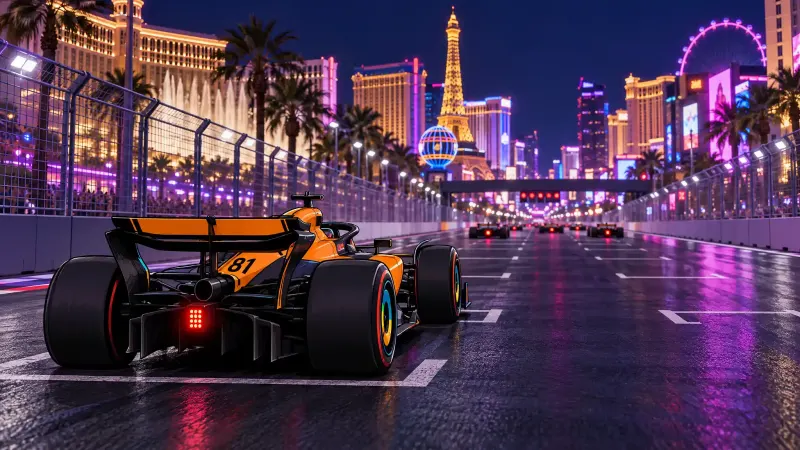
Starting from pole, the Dutchman had to win the lead back again and again from Russell, Norris and Antonelli. The top five finished within 2.927 seconds.
4 min read
McLaren Mastercard Formula 1 Team
United Kingdom of Great Britain and Northern Ireland
The number of Grands Prix in which the team has at least one car in the results. Methodology
The number of cars in the results. A Grand Prix with two cars counts twice, so this is higher than the number of Grands Prix. Methodology
Quick facts
| Official entry name | McLaren Mastercard F1 Team |
| Legal entity | McLaren Racing Limited |
| Founded | 1963, by Bruce McLaren (Bruce McLaren Motor Racing) |
| Base | McLaren Technology Centre, Woking, Surrey, England |
| Nationality | British racing licence |
| First Formula 1 season | 1966 (first race: Monaco Grand Prix) |
McLaren has won ten constructors' and thirteen drivers' championships in Formula 1 – but its most unusual achievement did not come in Formula 1 at all. By the team's own account it is the only outfit to have completed motorsport's Triple Crown: winning the Monaco Grand Prix, the Indianapolis 500 and the Le Mans 24 Hours.
In the late 1960s it won the American Can-Am series five years in a row – the dominance was so clear-cut that the series picked up the nickname "the Bruce and Denny show".
And the founder, Bruce McLaren, was a racing driver himself: he won the 1964 Tasman Series and was killed in a testing accident in 1970.
New Zealander Bruce McLaren set up the team in 1963 as Bruce McLaren Motor Racing. Its first base was in Feltham (1963–64), then Colnbrook (1965–1981), and today the McLaren Technology Centre in Woking.
The team made its Formula 1 debut at the 1966 Monaco Grand Prix and took its first Grand Prix win at the 1968 Belgian Grand Prix.
Bruce McLaren was killed in a testing accident in 1970; Teddy Mayer took over running the team.
McLaren has won ten constructors' championships (1974, 1984, 1985, 1988, 1989, 1990, 1991, 1998, 2024, 2025) and thirteen drivers' titles (1974, 1976, 1984, 1985, 1986, 1988, 1989, 1990, 1991, 1998, 1999, 2008, 2025). It stands at 205 race wins in all.
The team is a subsidiary of McLaren Group, which is wholly owned by Bahrain's Mumtalakat Holding Company.
Alongside Formula 1, McLaren has raced in several series for decades, and it took its biggest non-Formula-1 successes in American racing.
It won the Can-Am series five years running: Bruce McLaren in the M6A in 1967, Denny Hulme in the M8A in 1968, Bruce McLaren again in the M8B in 1969, Hulme again in the M8D in 1970 and Peter Revson in the M8F in 1971 – every car Chevrolet-powered. The team left the series after 1972.
A McLaren chassis first won the Indianapolis 500 in 1972: Mark Donohue in the M16B, though that car was entered by Penske Racing. The works team's wins came in 1974 and 1976, both with Johnny Rutherford.
The team raced in USAC from 1970 to 1979, returned with one-off Indianapolis 500 entries in 2017 and 2019, and has run full IndyCar seasons since 2020: Sam Schmidt Motorsports, taken over that year, became Arrow McLaren, which has won ten races since.
The 1995 Le Mans 24 Hours was won outright by a McLaren F1 road car converted for racing. The team plans to return to the World Endurance Championship in 2027 with an LMDh car, the McLaren MCL-HY.
It raced in Formula E from 2023 to 2025 with less success and then withdrew; it entered Extreme E from 2022 to 2024 and pulled out of that too. In 2022 it won the Formula 1 Esports Series championship.
| Year | Series / race | Car / driver | Result |
|---|---|---|---|
| 1964 | Tasman Series | Bruce McLaren | Champion |
| 1967 | Can-Am | McLaren M6A (Bruce McLaren) | Champion |
| 1968 | Can-Am | McLaren M8A (Denny Hulme) | Champion |
| 1969 | Can-Am | McLaren M8B (Bruce McLaren) | Champion |
| 1970 | Can-Am | McLaren M8D (Denny Hulme) | Champion |
| 1971 | Can-Am | McLaren M8F (Peter Revson) | Champion |
| 1974, 1976 | Indianapolis 500 | Johnny Rutherford | Win |
| 1995 | Le Mans 24 Hours | McLaren F1 GTR | Outright win |
| 2020 onward | IndyCar (Arrow McLaren) | — | Ten race wins |
| 2022 | Formula 1 Esports Series | — | Championship |
New Zealander Bruce McLaren, in 1963, as Bruce McLaren Motor Racing. The team made its Formula 1 debut at the 1966 Monaco Grand Prix.
Winning the Monaco Grand Prix, the Indianapolis 500 and the Le Mans 24 Hours. By the team's own account McLaren is the only outfit to have done all three.
Five, in consecutive years: Bruce McLaren in 1967 (M6A), Denny Hulme in 1968 (M8A), Bruce McLaren in 1969 (M8B), Hulme in 1970 (M8D) and Peter Revson in 1971 (M8F).
Yes. A McLaren chassis first won in 1972 with Mark Donohue, though that car was entered by Penske Racing. The works team won in 1974 and 1976, both times with Johnny Rutherford.
Yes. It raced in USAC from 1970 to 1979, returned with one-off Indianapolis 500 entries in 2017 and 2019, and has run full seasons since 2020: Arrow McLaren has won ten races since.
The 1995 Le Mans 24 Hours was won outright by a McLaren F1 road car converted for racing. The team plans to return to the World Endurance Championship in 2027 with the MCL-HY LMDh car.
Yes, from 2023 to 2025 with less success, after which it withdrew from the series. It entered Extreme E from 2022 to 2024 and pulled out of that too.
Race report ·
Starting from pole, the Dutchman had to win the lead back again and again from Russell, Norris and Antonelli. The top five finished within 2.927 seconds.
4 min read
News ·
The Australian is taking his fifth internal combustion engine of the season and will start the Las Vegas Grand Prix ten places behind his qualifying result.
3 min read
Race report ·
The polesitter took the lead after two Mercedes spins, Verstappen climbed from 21st to second, and Mercedes clinched the constructors' championship.
4 min read



We always use cookies that are necessary for the website to function. For analytics (Google Analytics, Matomo) and personalised ads (Google AdSense) we only do so with your consent. See details in our privacy policy.
With “Accept” you consent to all categories; under “More options” you can reject non-essential cookies or decide per category.
Choose which categories you allow, or reject all non-essential cookies. The page will reload after saving.
Necessary
Session, security and storage of your cookie preferences. Without these the site cannot function properly.
Analytics
Google Analytics and Matomo: anonymous or pseudonymised statistics about traffic and usage.
Marketing (ads)
Google AdSense: display of personalised or contextual advertisements.